
Lynn's story: The power of local support
Lynn, a regular visitor to her local community hub in Cornwall, is navigating the complexities of modern life while facing significant barriers to digital independence. Her story highlights the vital importance of community-led support and the "human-first" approach for those who find the digital world fundamentally inaccessible due to literacy challenges.
Lynn highlights a critical reality: for many, the internet is not a shortcut; it is a wall. Without the personal intervention of local support workers and family, essential tasks like securing housing or managing healthcare would be impossible.
Lynn’s problem: when digital first means people last
For Lynn, the push to move essential services online creates a disconnect that leaves her feeling stranded. She finds that traditional methods of communication are being eroded, replaced by systems that don't account for those who struggle with reading and writing.
Lynn highlights her three main troubles:
- Healthcare barriers: "Getting onto the doctor—no, I can’t do that. That was a bit hard because when I phone up, they say they’re going to give me a phone call back and you never get one."
- The literacy gap: "I just don’t like [the internet]. I don't really know [why]... I can't do texts very much because I can't read or write very good."
- Preference for the tangible: "To go online, I don’t do any shopping online. I’d rather go in and see the person in shop. Look what you’re buying."
The lifeline: community hubs and family support
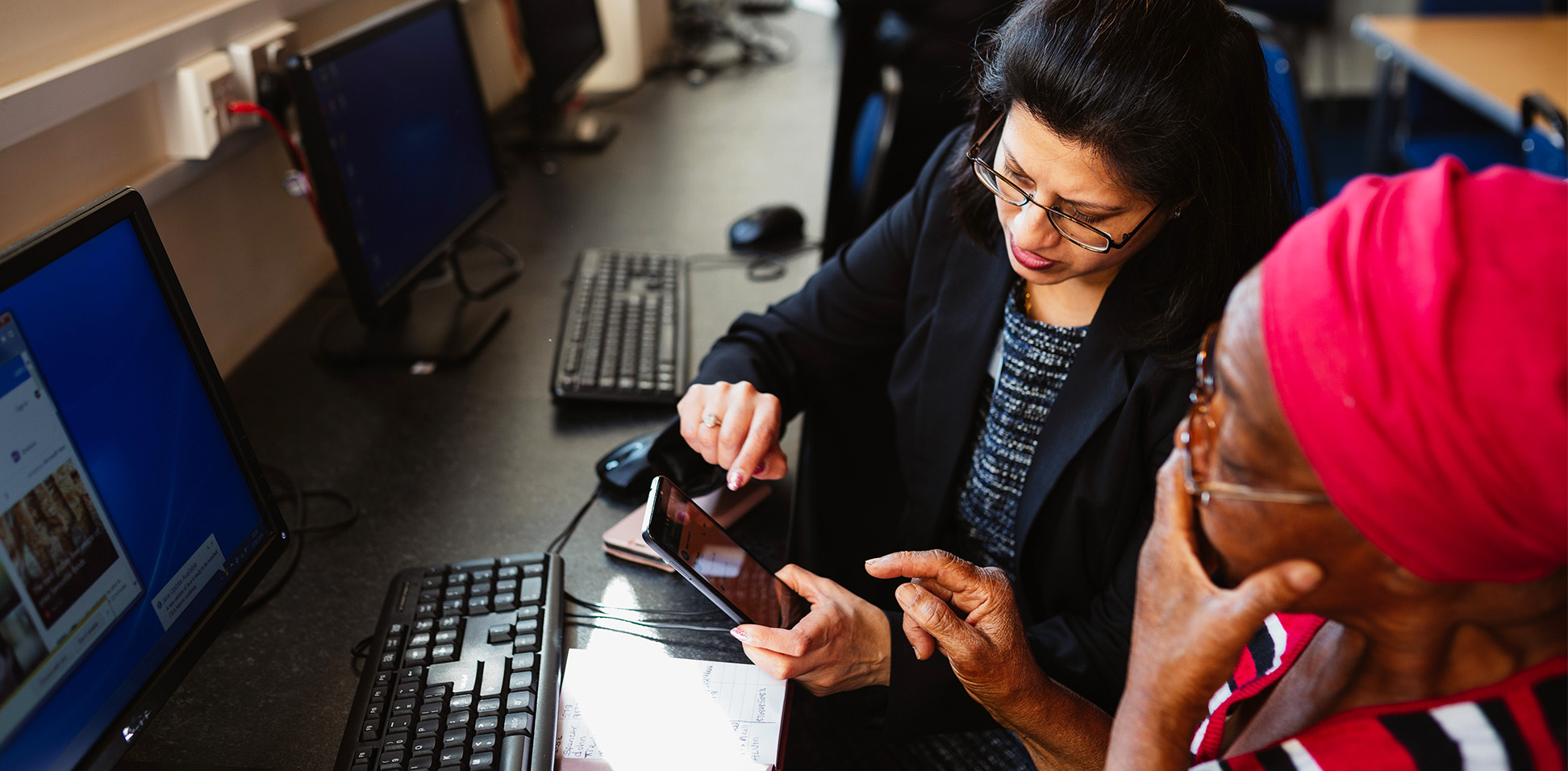
Lynn’s ability to manage her life rests entirely on a small network of trusted people. The local hub, Redruth Library, provides the digital skills and administrative support that the "digital-first" systems assume everyone already possesses.
Lynn told us:
- On the support at the hub: "I’ve learned a lot today. [Tamsin] turns in every Monday. She gets me onto housing and look at housing... Because I’ve got difficulty in writing and reading, she does all my letters for me and she goes on the internet for me and she texts everybody about my housing and everything for me."
- On healthcare advocacy: "Absolutely lots of stuff they help me with. With the surgery as well, getting me prescriptions on time and everything."
- On family networks: "If I didn't have Tamsin, I’d ask my son or his partner to do it for me, which they do do a lot for me anyway. They’ll ring up places for me... they are a big help because they come every day to see me and they take me out and everything they do."
Life changed by connection
For Lynn, the local library and hub are more than just places to access a computer; they are essential social anchors that prevent her from falling through the cracks of a system that is increasingly automated.
Lynn emphasised:
"The support from the library has changed my life as well as my son and his partner coming over my house as well, really, taking me out and taking me shopping and everything as well… What would I do if they couldn't support me? That I don't know because I'm not crossed that line yet."
Lynn’s message: Keep it social and accessible
Lynn’s experience offers a clear roadmap for how local authorities can better serve residents who are digitally excluded. Her story emphasises that technology should be a tool for connection, not a replacement for human interaction.
While Lynn is hesitant, she is open to trying new things if the barriers to entry (like cost and complexity) are removed. Lynn’s story is a testament to the fact that for many, the community is just as important as the service itself. Lynn describes coming into the hub as "like coming in to see friends," providing a level of comfort that a website or app can never replicate.
Lynn’s story serves as a reminder to service providers: for those with literacy difficulties, a digital-only world is a world of exclusion. The confidence, skills and access provided by community hubs are not a luxury - they are a necessity.
The What Works? Co-Lab report
We met Lynn during a series of pilots with Barnsley, Cornwall, and Middlesbrough Councils to test what really works. Now, you can discover proven strategies and actionable takeaways to help your local authority embed digital inclusion into core services.
You may also be interested in
-
 28/05/2026 Our news
Good Things launches National Toolkit to help Councils make digital skills a local priority
Good Things Foundation has released a new national report and practical framework designed to help Local Authorities embed digital inclusion into their services.
-
.png) 28/05/2026 Stories & case studies
28/05/2026 Stories & case studiesJulie’s story: Removing the mask of affluence in Cornwall
Julie Hawker, Chief Executive of Cosmic and Trustee of the Good Things Foundation, is witnessing a hidden crisis in the Southwest. While Cornwall is often viewed through the lens of tourism, Julie is highlighting the "disadvantage and suffering" beneath the surface. For many, digital exclusion is no longer just an inconvenience, it is a barrier to basic survival.