
Our Digital Nation
What is the state of the UK's digital divide? Each year, Good Things Foundation gathers new facts and stats to reveal the reality of digital exclusion.
Digital Nation 2026
The latest update of our Digital Nation infographic was launched in July 2026. It brings together recent data on digital exclusion and the impact of digital inclusion support from a range of sources, including Lloyds’ UK Consumer Digital Index and Essential Digital Skills reports (2025), Ofcom’s Communications Affordability Tracker (April 2026), and Good Things Foundation’s internal monitoring and evaluation impact reporting.
For the first time, this year’s infographic also features data gathered using Good Things Foundation’s Indicators of Digital Inclusion (IDIs). Developed collaboratively with cross-sector experts, the IDIs act as a unified measurement tool designed to show the depth and breadth of digital inclusion and the barriers that impact whether someone can participate fully in a digital society. Several key statistics in this edition are drawn from our analysis of the Money and Pension Service using these indicators in their 2026 MoneyView survey.
Please use and share this free resource, crediting Good Things Foundation and linking to our webpage so others can also access the full list of sources.
Please email our Research, Data & Insights team at research@goodthingsfoundation.org to access any of our previous Digital Nation reports from 2016-2025.
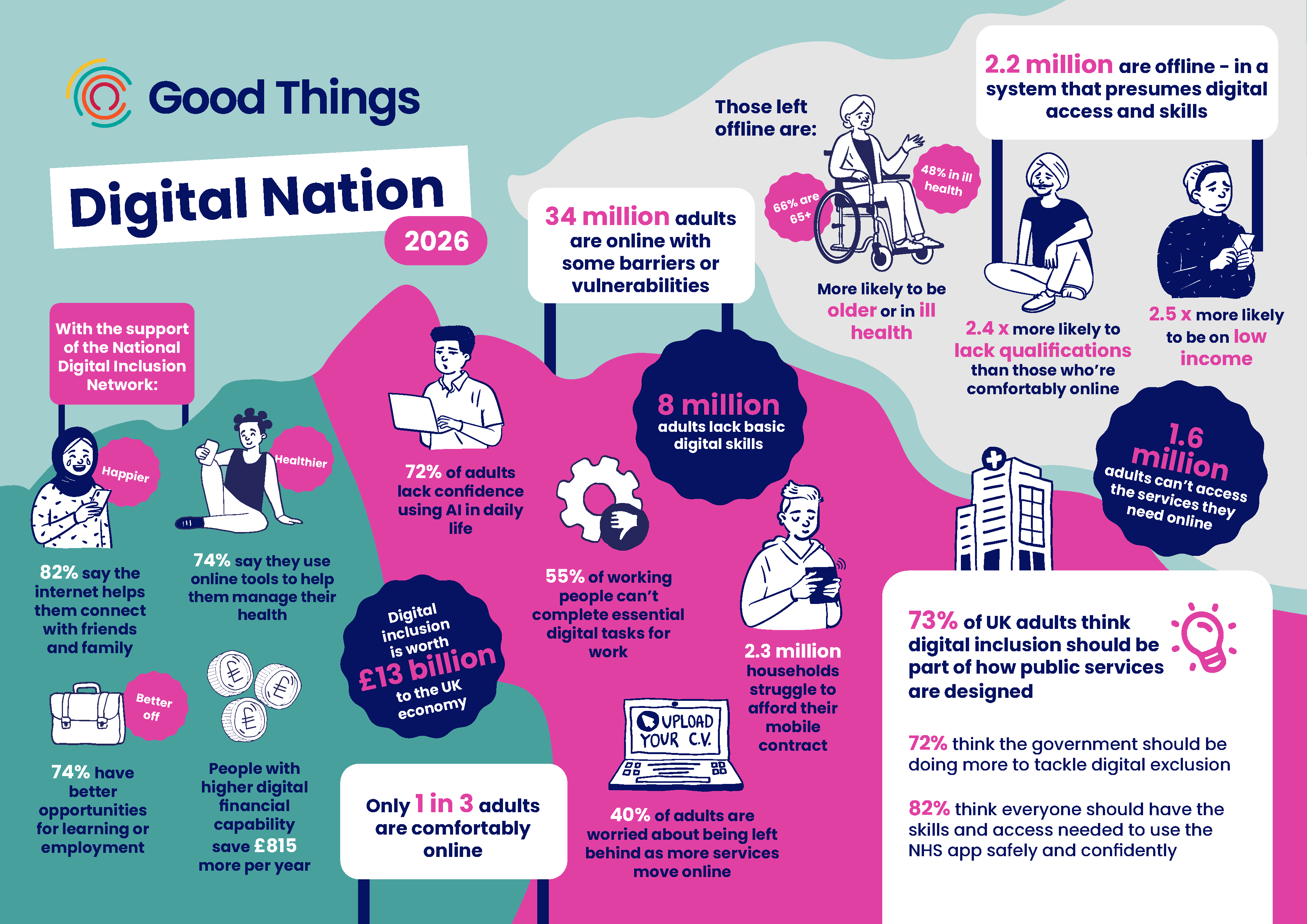
Show image description Hide image description
Our Digital Nation accessibility description
Digital Nation 2026 is a graphic with statistics about digital inequalities in the UK. The graphic shows a vibrant wavy landscape with teal and pink sections to convey the different dimensions of the digital divide, with images of people, buildings and digital technology arranged around the key statistics. The left section captures the benefits of receiving digital inclusion support for individuals, showing how they become happier, healthier and better off. The central and right sections capture the scale of digital exclusion, detailing how people are facing barriers to online services, lacking basic skills and confidence with newer technologies like Artificial Intelligence, who is most likely to be affected, and what the public think.
Illustrative signposts and callout boxes placed throughout the landscape depict the key aspects of capability and vulnerability, highlighting the reality that only one in three adults are currently comfortably online. A dedicated public opinion section emphasises what the British public think about how public services should be designed and how the government should tackle digital exclusion.
Good Things Foundation is the UK’s leading digital inclusion charity, working in partnership across the UK to Fix the Digital Divide for Good. Each year, we collate statistics from national datasets, public polling, and authoritative analysis to convey key facts about digital exclusion and inclusion in the UK. The full set of sources is provided below.
Scale of the digital divide
| Scale | Stats |
|---|---|
|
The Big Picture These statistics are presented within the main landscape across the central and right sections: |
|
|
People Left Behind These statistics are featured in the top right section, with illustrated characters to represent the communities most affected by being completely offline: |
|
|
What the Public Think These statistics are featured at the bottom right of the graphic, a white display panel shows the following statistics regarding public perception: |
|
|
Digital Inclusion Benefits These statistics are featured on the left section of the landscape, several illustrated characters display the personal benefits of digital inclusion with the support of the National Digital Inclusion Network: |
|
Digital Nation sharing and citation
Please use and share this free resource, crediting Good Things Foundation and linking to our webpage so others can also access the full list of sources. Recommended citation: Digital Nation 2026, Good Things Foundation. Sources at: Digital Nation 2025, Good Things Foundation.
Digital Nation sources and references
CEBR, for Good Things Foundation (2022), The economic impact of digital inclusion in the UK
Good Things Foundation (2026a), Indicators of Digital Inclusion. The 2026 MoneyView survey, conducted by the Money and Pensions Service, incorporated the Indicators of Digital Inclusion. With their permission, Good Things Foundation analysed this data to produce these findings. This dataset is available through the UK Data Service MaPS MoneyView Survey - Dataset - Geographic Data Service.
Good Things Foundation (2026b), Internal impact reporting. Good Things Foundation sent a short survey to all people that have been supported by our network who have given us permission to contact them and for whom we have appropriate contact details. Responses are not incentivised and therefore the data we collect is from a self-selecting, non-representative sample. 3736 responses between Jan 24 and Mar 26.
Ipsos, for the Department for Science, Innovation and Technology (DSIT) and the Department for Culture, Media and Sport (DCMS) (2026), AI Skills for Life and Work: General Public Survey Findings
Lloyds Banking Group (2025a), Consumer Digital Index report 2025
Lloyds Banking Group (2025b), Essential Digital Skills 2025
Ofcom (2026), Communications Affordability Tracker, April 2026
Public First (2026), Polling for Good Things Foundation. Online survey conducted 29 May - 2 June 2026; sample size 2,076 UK adults, weighted by interlocking age & gender, region and social grade to Nationally Representative Proportions
.png)