
Tricia’s story: Bridging the creative gap in Cornwall
For Tricia, a professional concept artist who has worked on legendary productions like Doctor Who and Disney, imagination has never been the problem. However, as the world moves toward an exclusively digital future, Tricia finds herself facing a "digital wall" that threatens to stall her career and deepen her isolation in rural Cornwall.
The problem
Despite her high level creative background, Tricia’s daily life is a stark reminder of the digital divide. She currently relies on a basic "button mobile" that is reaching the end of its life, leaving her disconnected from the tools most professionals take for granted.
- The 4G cliff edge: Tricia is facing a looming deadline. Her current device will soon go offline as networks upgrade. "I have to get a new phone, a 4G one, by Christmas as it'll go offline," she explains. For an artist who relies on high quality photos for her work, the transition to a smartphone is an expensive necessity she feels "behind” on.
- Health and memory barriers: Living with epilepsy and a short-term memory that can fade within weeks, Tricia finds standard digital learning difficult. "Things might only last for me for a week or a month... I’d have to start again from scratch."
- The "total cut off": During the 2019 lockdowns, Tricia was left completely stranded. With no internet at home and community spaces closed, her professional world stopped. "Everything was cut off for me. I had to carry on writing a book on paper at home."
The solution: community hubs as a creative lifeline
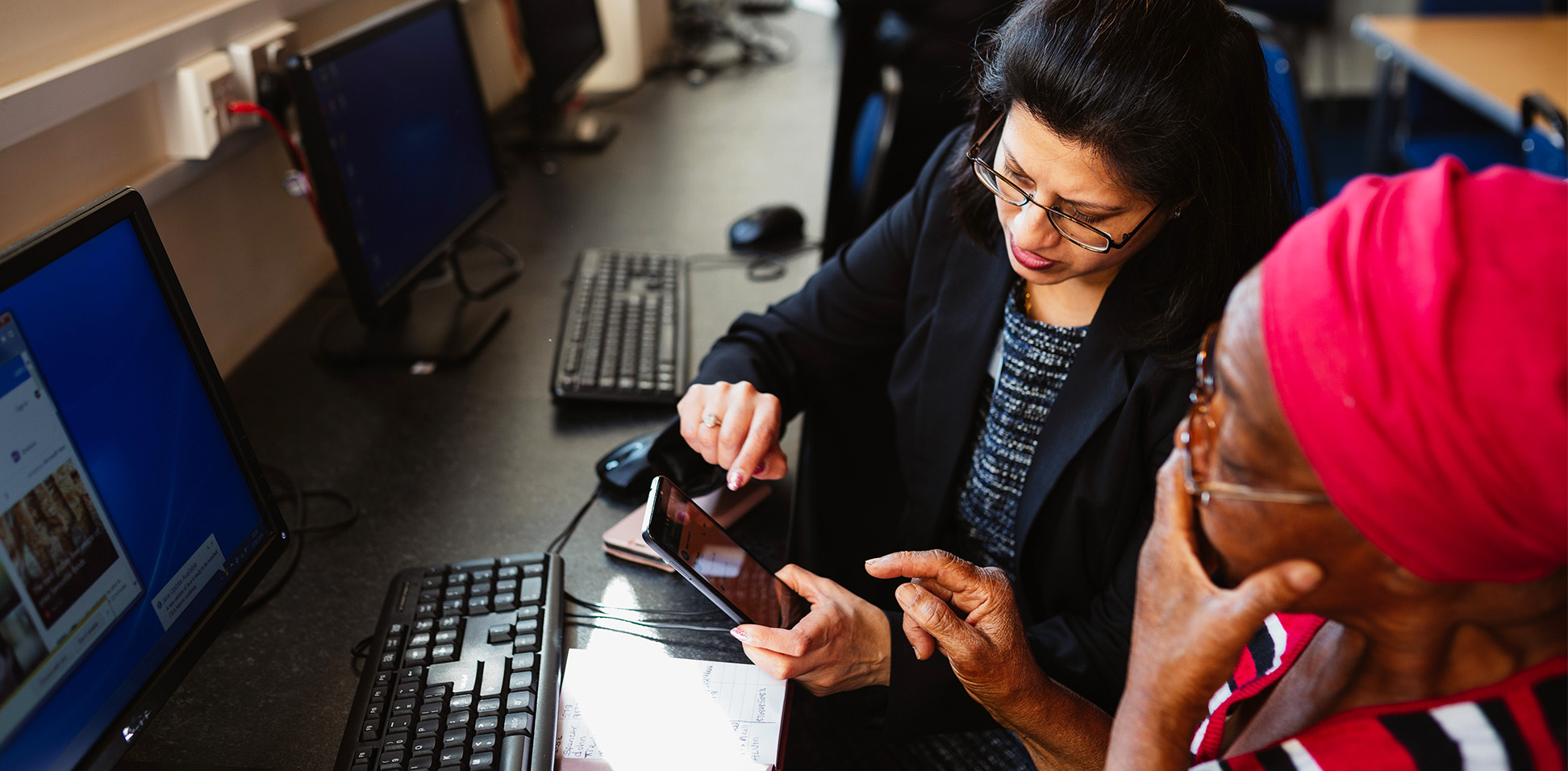
Tricia’s story highlights how community networks like the local library and The Elms do more than provide computers, they provide a "light friendly" sanctuary for ambition.
Through the Hub, Tricia is transforming her handwritten science fiction project, Questran Eda, into a publishable reality. With the support of staff, she uses the computers to type up her manuscript and research images - tasks she simply cannot perform in her small, dimly lit flat.
"I’d rather come up here and spend an hour or two," Tricia says. "If I get in trouble technically... the librarians here always help me out so I’m not stuck." The Hub has allowed her to maintain a relationship with publishers and even share her work with Sir David Attenborough, who sent her a letter of encouragement to persevere with her book.
Tricia’s call for change
Tricia believes that digital inclusion in rural areas requires more than just providing a Wi-Fi password; it requires a structural commitment to accessibility:
- Localised, consistent learning: Tricia advocates for proper, weekly public courses in remote areas. For those with memory or health challenges, one-off sessions aren't enough. Trisha believes they need ongoing support.
- Physical and financial access: Digital inclusion is hindered by physical isolation. Tricia points out that round trip bus fares in Cornwall can cost up to £12, a major barrier for those seeking help. She suggests financial support for travel and better non-digital advertising so people know where to find help.
- Combating isolation: Beyond business, the Hub is a mental health necessity. "You can become quite isolated and cut off without even knowing it," she warns. For Tricia, the Hub is a place to "regenerate confidence" and force oneself out of the inward-facing spiral of loneliness.
As Tricia looks toward 2026, her dream is to see her book published and to move into a working studio.
"The internet is a good way to keep in touch, at least you've got the options. But you have to be able to stay connected."
The What Works? Co-Lab report
We met Tricia during a series of pilots with Barnsley, Cornwall, and Middlesbrough Councils to test what really works. Now, you can discover proven strategies and actionable takeaways to help your local authority embed digital inclusion into core services.
You may also be interested in
-
.png) 08/06/2026 Stories & case studies
08/06/2026 Stories & case studiesJoy’s story: The digital wall pushing Barnsley residents to the edge
Joy, a resident of Barnsley, is witnessing the effects of digital exclusion firsthand. She speaks out about her struggles with digital exclusion, and highlights the countless vulnerable people being pushed to the brink by the compulsory shift to 'digital-first' essential services.
-
.png) 28/05/2026 Stories & case studies
28/05/2026 Stories & case studiesJulie’s story: Removing the mask of affluence in Cornwall
Julie Hawker, Chief Executive of Cosmic and Trustee of the Good Things Foundation, is witnessing a hidden crisis in the Southwest. While Cornwall is often viewed through the lens of tourism, Julie is highlighting the "disadvantage and suffering" beneath the surface. For many, digital exclusion is no longer just an inconvenience, it is a barrier to basic survival.
-
 28/05/2026 Our news
Good Things launches National Toolkit to help Councils make digital skills a local priority
Good Things Foundation has released a new national report and practical framework designed to help Local Authorities embed digital inclusion into their services.