Affordable internet access for all: Towards a Greater Manchester roadmap for action
Hundreds of thousands of Greater Manchester households struggle to afford getting online; this five-year roadmap developed by Greater Manchester Combined Authority, Autotrader, University of Liverpool and Good Things Foundation sets out how to ensure internet access is affordable for all in the city.
Executive summary
No one should be locked out of work, healthcare, education or opportunity because they cannot afford to get online. Yet across Greater Manchester, thousands of households face exactly this barrier.
Drawing on new analysis of the ONS Living Costs and Food Survey, an estimated 221,000 households in Greater Manchester spend 3% or more of their income on internet costs alone, 56,000 households in poverty could not afford even a discounted social tariff, and 33,000 low-income households rely on mobile-only connectivity.
This is more than a connectivity problem. When people cannot get online reliably, they risk exclusion from essential services, such as the NHS, social security benefits, education, and employment support. People experience heightened stress, isolation and disadvantage. Being unable to afford sufficient, reliable connectivity - data poverty - compounds existing inequalities and deepens the cost-of-living crisis for those least able to absorb it.
This five-year roadmap is the product of a collaborative discovery project between Greater Manchester Combined Authority, Autotrader, Good Things Foundation and the University of Liverpool. It draws on desk research and expert stakeholder workshops, as well as resident and community engagement in the region. Serving as a foundation for further collaboration and development, the roadmap presents a five-year framework for action, built around four focus areas:
- Social housing: towards ensuring every social housing tenant can access affordable broadband, by tackling infrastructure barriers, strengthening the Greater Manchester Good Landlord Charter, and embedding connectivity into new housing developments.
- Cost-of-living and financial inclusion: towards ensuring low-income households can access connectivity that meets their needs, through effective use of discretionary funds (such as the current Crisis & Resilience Fund), and local promotion of national social tariffs.
- Community spaces and local infrastructure: towards ensuring free, secure public WiFi is available in trusted local spaces such as libraries, Live Well Centres and community organisations, building on the GM One Network.
- Priority groups: towards ensuring internet access, and digital inclusion, are ‘baked in’ to strategic commissioning of statutory provision for priority groups, such as people and families in temporary or unstable housing, and care leavers.
Each focus area sets out a five-year commitment, describes the current picture, and proposes a mix of potential ‘quick wins’, short-to-medium term actions, and longer-term opportunities, identifying the stakeholders best placed to lead delivery.
Greater Manchester already has a strong foundation to build on, including the Greater Manchester Databank, the Care Leavers Guarantee, Connected Homes Inclusive Places, and Live Well initiative. The roadmap shows that more action is needed, and is feasible. National-level change is also essential; no region, strategic or local authority can solve data poverty alone. Greater Manchester can demonstrate what regional collaboration can achieve, and offer a testbed for the national solutions still needed to ensure that, within five years, no one in Greater Manchester is offline because of poverty.
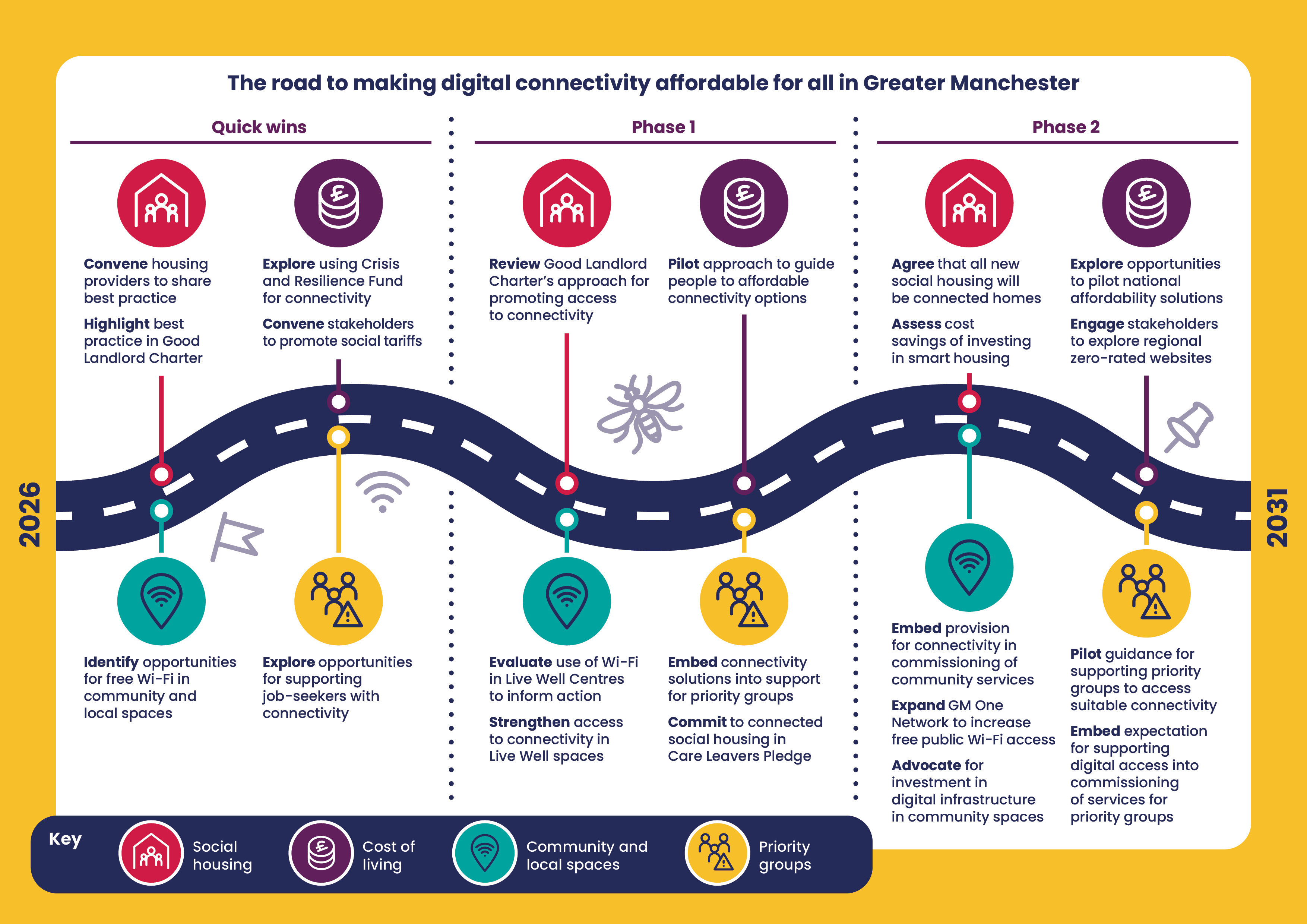
Show image description Hide image description
A diagram showing a roadway running horizontally across the middle of the page, with 2026 on the left and 2031 on the right. There are three segments organised horizontally across the page, labelled ‘quick wins, ‘phase 1’, and ‘phase 2’. In each segment there are four icons, connected to the road with lines. A key at the bottom explains the four icons: social housing, cost of living, community and local spaces and priority groups.